
Expected Value (EV) in Sports Betting: How to Calculate It and Why It Matters

What Is Expected Value in Sports Betting
Expected Value, usually shortened to EV, is one of the most important concepts in sports betting. It helps bettors understand whether a wager is profitable in the long run rather than whether it simply wins or loses on a particular day.
That distinction matters more than many beginners realize. A single winning bet does not automatically mean it was a smart decision, just as a losing bet does not always mean it was a bad one. Expected Value shifts the focus away from short-term outcomes and toward long-term logic.
In practical terms, EV measures the average return you can expect from a bet if you were able to place the same wager many times under the same conditions. If that average return is positive, the bet is considered profitable over time. If it is negative, the bet is likely to lose money in the long run, even if it wins occasionally.
This is why EV is so central to serious betting. It introduces structure, logic and discipline into a space where many people otherwise rely too heavily on instinct or emotion.
Why EV Matters More Than Individual Results
One of the biggest mistakes in sports betting is judging decisions only by what happened after the final whistle. That approach may feel natural, but it is deeply misleading.
A bettor can place a poor wager on an overpriced favourite, watch it win comfortably, and walk away believing the decision was correct. On the other hand, another bettor can back a well-priced underdog with genuine value, lose narrowly, and think the bet was a mistake. In reality, the second bettor may have made the stronger long-term decision.
Expected Value helps separate process from outcome. It asks a more useful question: was the price offered better than the true probability of the event happening?
This is what makes EV so powerful. It allows bettors to evaluate the quality of a wager independently from short-term variance. Over a small sample, luck can distort almost anything. Over a large sample, however, consistently taking positive EV bets is what gives a bettor a chance to be profitable.
A strong betting strategy is not built on always being right. It is built on making decisions that are mathematically favourable often enough for the edge to show over time.
The Basic Idea Behind EV
At its core, Expected Value compares two things:
- the probability that an outcome will happen
- the odds being offered on that outcome
If the odds imply a lower probability than your own realistic estimate, the bet may have positive Expected Value. If the odds imply a higher probability than reality, the bet is likely negative EV.
This is why EV is closely linked to pricing. Betting is not just about predicting winners. It is about identifying when the market price is wrong or at least generous enough to create long-term value.
For example, imagine a team is offered at odds of 2.20. Those odds imply a certain level of chance. If your analysis suggests the team has a better chance than the odds suggest, you may have found a positive EV opportunity. If your estimate is lower than the market’s implied probability, the bet is probably not worth taking.
This mindset is what separates analytical betting from casual guessing. The goal is not to ask, “Do I think this team will win?” The better question is, “Are these odds better than they should be?”
How to Calculate Expected Value
The standard EV formula in betting is relatively simple once broken down clearly.
A practical version looks like this:
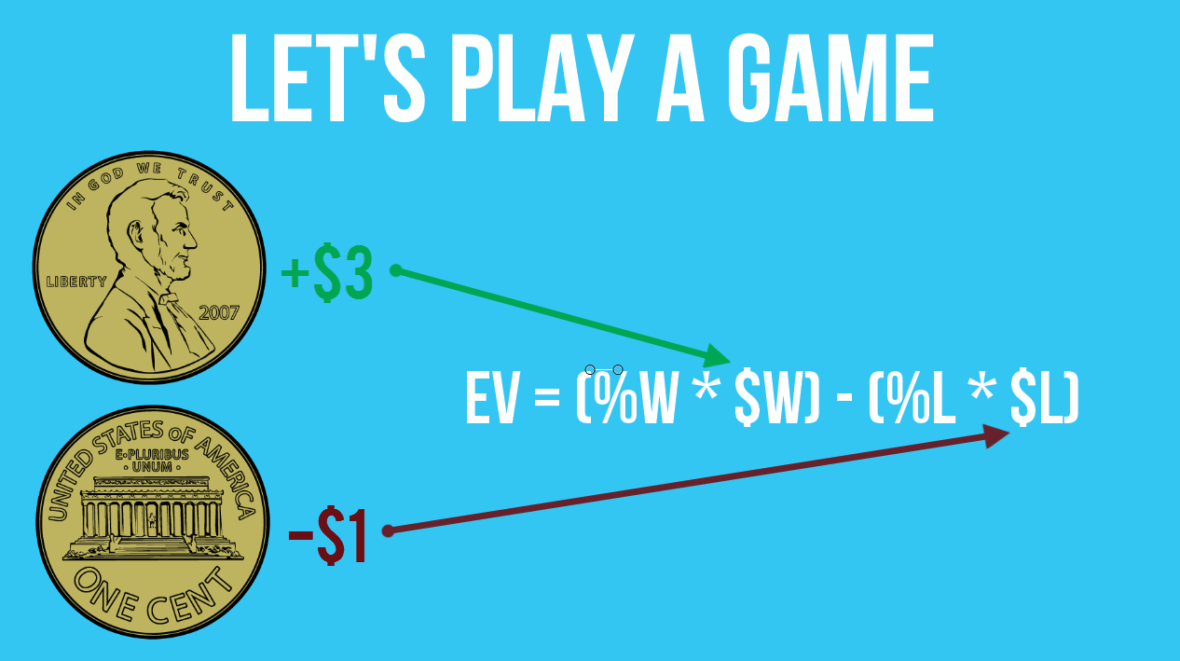
EV = (Probability of Winning × Profit if Win) – (Probability of Losing × Stake)
This can sound technical at first, but the logic is straightforward. You are calculating the average gain from winning scenarios and subtracting the average loss from losing scenarios.
Let’s use a simple example.
You place a €100 bet at odds of 2.00. Your estimated probability of winning is 55%.
If the bet wins, your profit is €100.
If the bet loses, your loss is €100.
So the calculation becomes:
- 55% × €100 = €55
- 45% × €100 = €45
EV = €55 – €45 = +€10
That means the expected return per €100 bet is plus €10 over the long run. The bet may still lose today, tomorrow or several times in a row, but if your probability estimate is accurate, this is a profitable decision over time.
Once understood this way, EV becomes much less intimidating. It is simply a framework for evaluating whether the average long-term return of a bet is positive or negative.
Understanding Positive EV and Negative EV
Not every bet is created equal. Some wagers offer prices that favour the bettor, while others are designed to favour the market heavily. Expected Value is the clearest way to distinguish between the two.
A positive EV bet is one where the long-term average return is above zero. It means the odds are better than your assessed probability of the outcome. These are the kinds of bets serious bettors seek.
A negative EV bet is one where the long-term average return is below zero. It means the price on offer is not good enough, even if the bet looks appealing on the surface.
This is where many casual bettors go wrong. They often focus on what feels likely to happen rather than whether the odds justify the risk. A strong favourite may win often, but if the price is too low, backing it repeatedly can still be a losing strategy over time.
The same applies to outsiders. A longshot may feel unlikely, but if the odds are generous enough compared to the true chance of success, the bet may still be valuable.
A useful way to think about it is this:
- positive EV means you are buying at a good price
- negative EV means you are paying too much
That logic applies regardless of whether the selection is a favourite, an underdog, an over/under market or any other type of wager.
A Simple EV Example with Decimal Odds
Decimal odds are especially useful for understanding Expected Value because they make probability comparisons easier.
Suppose a player is offered at 3.00 to score first. Decimal odds of 3.00 imply a probability of roughly 33.33%. Now imagine your analysis suggests the player’s true chance is closer to 40%.
That gap is important. If the market is pricing the outcome as if it happens one-third of the time, but your estimate suggests it should happen four times in ten, then the offered odds may be too high.
Using a €100 stake:
- If the bet wins at 3.00, the profit is €200
- If it loses, the loss is €100
- Estimated win probability = 40%
- Estimated loss probability = 60%
The EV becomes:
- 40% × €200 = €80
- 60% × €100 = €60
EV = €80 – €60 = +€20
That is a positive EV bet. It will still lose more often than it wins, because 40% is below 50%, but the price compensates for that risk well enough to make it profitable in theory over a large sample.
This is one of the most important lessons in betting. You do not need to win most of your bets to be successful. You need to take prices that are better than they should be.
EV and Implied Probability
To use EV properly, bettors need to understand implied probability. This is the probability suggested by the odds themselves.
In decimal format, the formula is simple:
Implied Probability = 1 / Decimal Odds
For example:
- odds of 2.00 imply 50%
- odds of 1.50 imply 66.67%
- odds of 4.00 imply 25%
This number gives you a baseline for comparison. Once you know what the market implies, you can compare it with your own estimate.
If your estimated probability is higher than the implied probability, there may be value. If it is lower, there usually is no value. That is the practical bridge between price and EV.
This step also helps bettors stop thinking in vague terms. Instead of saying a team is “very likely” to win, you begin thinking in percentages. That shift alone often improves decision-making, because it forces more precision and reduces emotional betting.
EV vs Value Betting: What Is the Difference
Expected Value and value betting are closely related, but they are not exactly the same thing.
Value betting is the broader concept. It refers to the idea of placing bets where the odds are higher than the true probability of the outcome. In other words, you are backing selections that appear mispriced.
Expected Value is the mathematical expression of that idea. It quantifies whether that value is positive or negative and by how much.
A simple way to frame the difference is this:
- value betting is the principle
- EV is the calculation behind it
In practice, the two work together. A bettor identifies a potentially mispriced selection through research and judgment, then uses EV logic to determine whether the bet is worth taking.
This distinction is useful because it shows that value is not just a vague opinion. It can be measured and tested. That makes betting more rigorous and helps separate educated decisions from guesswork.
Why You Can Have Good EV and Still Lose
This is one of the hardest ideas for newer bettors to accept. A bet can have positive EV and still lose. In fact, even a large group of positive EV bets can lose over a short period because variance is unavoidable.
That does not mean the strategy is broken. It means probability is not the same as certainty.
If you place a bet with a 55% chance of winning, that still means it loses 45% of the time. Over ten bets, twenty bets or even fifty bets, short-term results can look messy. A profitable edge only becomes clearer over a larger sample.
This is where many bettors lose discipline. They expect good decisions to produce immediate rewards and bad decisions to fail instantly. Betting rarely works that cleanly.
Positive EV is about long-term expectation, not short-term comfort. A good bettor must be able to tolerate temporary losing streaks without abandoning sound logic. This is why EV and bankroll management are so closely connected. Even a strong edge is useless if poor staking causes the bankroll to collapse before the maths has time to work.
Understanding this point changes the entire mindset of betting. It becomes less about emotional reactions and more about trusting a disciplined process.
The Role of Estimation: Why EV Is Only as Good as Your Numbers
Expected Value is powerful, but it is not magic. Its usefulness depends entirely on the quality of the probability estimates behind it.
If your probability assessment is poor, your EV calculation will also be poor. That is why estimating true chances accurately is one of the hardest parts of betting.
A bettor might believe a team has a 60% chance of winning when the true figure is closer to 48%. On paper, the EV may look positive. In reality, the bet may be negative. The formula itself is not wrong, but the input is.
This is why EV should not be treated as a shortcut. It is a tool that becomes valuable only when supported by honest, careful analysis.
Useful inputs often come from:
- team or player performance data
- tactical matchups
- injuries and absences
- schedule and fatigue factors
- market movement and price comparison
The stronger your evaluation process, the more meaningful your EV judgments become. Without that foundation, even mathematically neat calculations can create false confidence.
Common Mistakes Bettors Make with EV
A lot of bettors become interested in Expected Value but then apply it incorrectly. The concept itself is solid, yet misuse is common, especially when people want simple answers from a complex process.
One frequent mistake is overestimating probabilities. Many bettors are naturally optimistic about their own picks and assign win chances that are too high. This inflates EV on paper and creates a false sense of value.
Another mistake is confusing likely outcomes with profitable prices. A strong favourite can look safe, but if the odds are too short, the bet may still have negative EV. Probability and price always have to be assessed together.
A third issue is ignoring market margin. Odds are not neutral. They include built-in margin, which means many available prices are naturally negative EV unless the bettor finds a genuine edge.
Other common problems include:
- using emotional judgments instead of realistic percentages
- failing to compare prices across markets
- focusing only on winners instead of decision quality
- assuming a few wins prove a strategy is profitable
The lesson is clear: EV is not just about doing one formula. It is about building a disciplined framework for evaluating bets honestly.
How to Use EV in Real Betting Decisions
Expected Value becomes most useful when it moves from theory into routine decision-making. Bettors do not need to calculate complex models for every selection, but they do need to think in EV terms consistently.
In practice, this means asking structured questions before placing a bet:
- What probability do I realistically assign to this outcome?
- What probability do the odds imply?
- Is the difference large enough to justify the risk?
- Am I being objective, or am I forcing a bet?
This kind of thinking naturally improves discipline. It reduces impulsive wagers and encourages selectivity. Not every match needs a bet, and not every opinion translates into value.
A strong EV-based approach also encourages patience. Sometimes the best decision is to wait, pass, or accept that the current number is too efficient to attack. That mindset may feel less exciting in the moment, but it is much healthier in the long term.
Good bettors are not constantly chasing action. They are waiting for prices that make sense.
EV, Discipline and Long-Term Thinking
Expected Value cannot be separated from mindset. It is one thing to understand the formula; it is another to stay committed to it during real winning and losing streaks.
An EV-based bettor has to think beyond today’s results. That requires patience, emotional control and confidence in process over noise. The reward is not instant certainty, but a more rational and sustainable approach to betting.
This is also why discipline matters so much. When bettors abandon their process after a few losses or become reckless after a hot streak, EV stops being useful because consistency disappears.
Over time, the goal is not simply to find occasional good bets. The goal is to build a repeatable framework:
- estimate realistically
- compare price to probability
- take positive EV opportunities
- manage risk properly
- review decisions honestly
That is how betting becomes more professional, regardless of whether someone is betting casually or seriously.
Final Thoughts: EV as the Foundation of Smarter Betting
Expected Value is not the only concept that matters in sports betting, but it is one of the most important. It teaches bettors to stop judging wagers only by short-term outcomes and start thinking in terms of long-term profitability.
That shift is fundamental. It changes betting from a results-driven hobby into a process-driven discipline. Once you begin evaluating bets through the lens of probability, price and long-run expectation, decision-making becomes clearer and more consistent.
EV does not eliminate uncertainty, and it does not guarantee immediate profit. What it does provide is a better standard for judging whether a bet actually makes sense.
In the long run, that is what matters most. Winning bettors are not simply the ones who predict the most outcomes correctly. They are the ones who repeatedly place wagers where the risk and the price are in their favour.
You May Also Like
• Value Betting Explained: How to Identify Profitable Odds and Beat the Market
Expected value is closely linked to finding profitable betting value in the market.
• How Betting Odds Work: Decimal, Fractional & American Explained
Learn how bookmaker odds translate into probability before calculating EV.
• Bankroll Management in Sports Betting: Complete Guide to Staking and Risk Control
Even positive EV betting strategies need smart bankroll control to succeed long term.
